Showing posts with label Vegetarian Curries. Show all posts

Thursday, January 10, 2013

Aaloo Subzi ( Gujarati Style)

          Potato has a very important place in North Indian cuisine. Their everyday meal usually consists of at least one potato dish like potato curry, Aaloo paratha etc. Gujarati cuisine mainly consists of vegetarian food most of which exhibits a distinctive sweet, salty and spicy flavor. This is one such dish.


INGREDIENTS
Potato                                         - 3 Big, peeled,boiled with salt & diced
Oil (Preferably peanut oil)            - 3 Tbsp
Mustard seeds                             - 1 tsp
Cumin seeds                                - 1 tsp
Chilli powder                               - 2 tsp
Turmeric powder                         - 1/2 tsp
Coriander powder                       - 2 tsp
Dried Red Chillies                        - 2
Curry leaves                                - 1-2 twigs
Asafoetida                                   - 1/4 tsp
Amchoor (Dried mango powder) - 1 tsp
Garam Masala                             - 1/2 tsp
Sugar                                           - 1 tsp
Roasted peanut powder               - 2 Tbsp
Salt                                             - To taste
Cilantro                                       - 1/2 bunch, chopped roughly

METHOD
             Mix the boiled & diced potatoes with chilli powder, coriander powder, turmeric powder, sugar, amchoor, garam masala and peanut powder.
              In a nonstick pan heat the oil. When the oil is hot enough add the mustard seeds, cumin seeds, Red chillies and curry leaves one by one. When the spluttering subsides add the potato-spice mix and stir well so that the entire mix is coated with the oil. Sprinkle with some water so that the mixture won't go dry adjust the salt as needed. Stir intermittently till the whole mix gets a light golden brown color. Towards the finishing stage add the chopped cilantro and mix once. Remove from heat.
                This dish goes well with chapatis & parathas.

Tuesday, January 8, 2013

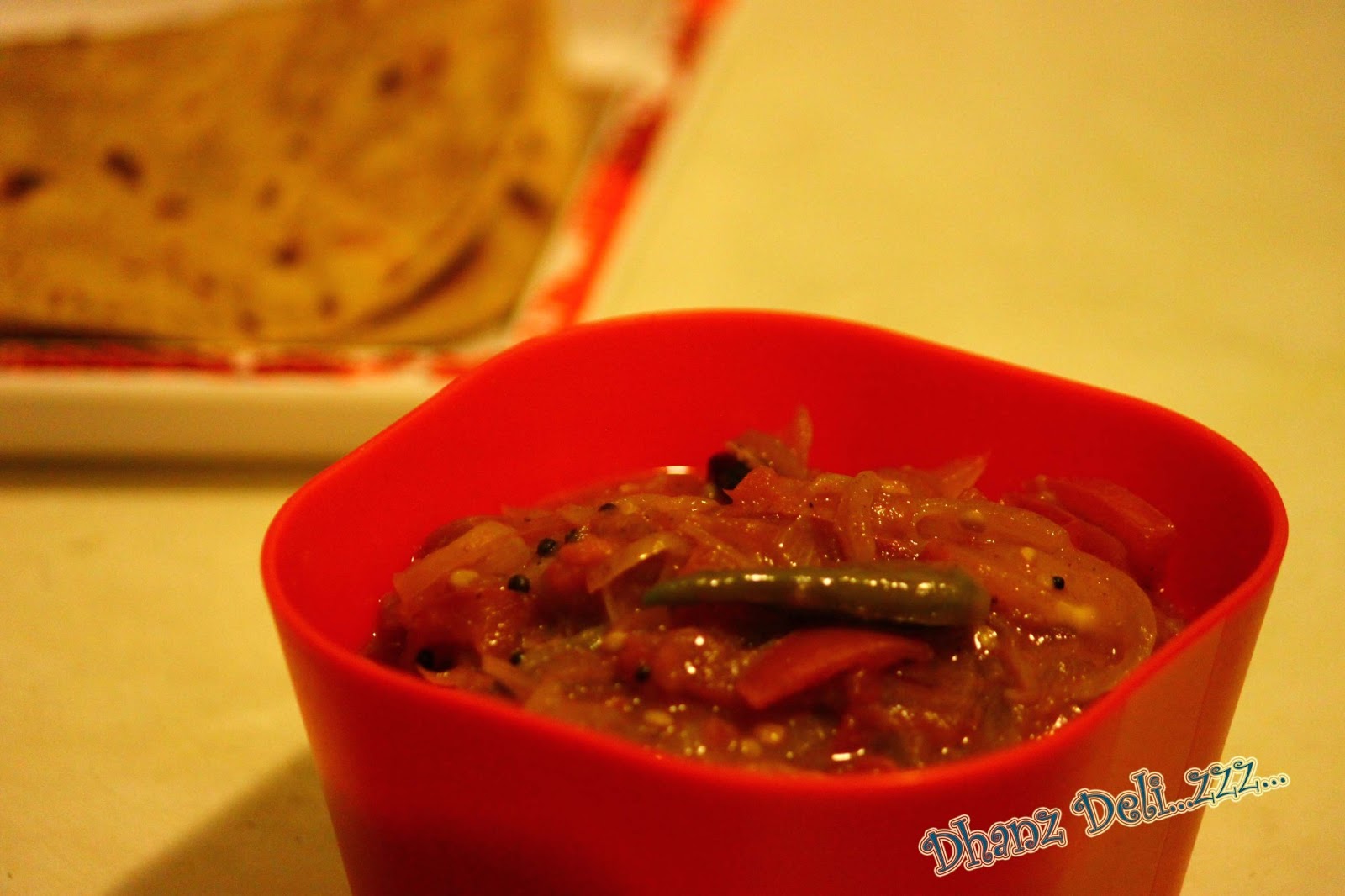
Simple Tomato Curry

 This is a very easy dish which can be made so fast and makes a very good curry for chapati rice or any other dish. Tomatoes are one type of vegetable that is always present in my household. My husband loves tomato based dishes so much. This is one of the frequently made dishes whenever I'm in a hurry-burry or when I'm not in a mood of any serious cooking.


INGREDIENTS
Tomato                 - 3 Medium sized, chopped into small cubes
Onion                    - 1 Big, chopped
Green chillies         - 2-3 slit lengthwise
Mustard seeds      - 1 tsp
Dried red chilli      - 2
Curry leaves         - 1 twig
Chilli powder       - 1 tsp
Turmeric powder - 1/4 tsp
Salt                      - to taste
Oil                       - 2-3 Tbsp

METHOD
                 Heat oil in a kadai or nonstick skillet. Add the mustard seeds, red chillies and curry leaves and allow them to splutter. Now add the onions and green chillies and saute till translucent. The mix in the tomatoes and saute them till they become mushy and soft. When the oil begins to separate add the chilli powder, turmeric powder and salt. Pour 3/4 cup water and close with a lid. Allow it to cook for about 2-3 minutes. Then remove the lid and allow the excess water to evaporate and let the curry turn into semi-gravy stage. Remove from heat.
                  Serve it hot with chapati, Appam, Idiyappam or plain white rice.

Mixed Vegetable Stew

     Stew is a rich and mildly spicy recipe made with vegetables or chicken or mutton. Here I'm posting a vegetable stew which itself is highly nutritious with its wide array of different vegetables simmered in thick coconut milk gravy and is the ideal companion of Appam, Idiyappam, etc. You can even try it with chapati (Indian bread) also.

     
INGREDIENTS
Onions                  - 1 Big, chopped
Carrots                 - 2 Big, cut into 1' long thick pieces
Potato                   - 1 Big , cut into square pieces
Cauliflower           - 1/2 floret, cut into small florets
Green Beans         - 1/4 lb, cut into 1" pieces
Peas                     - 1/2 cup
Green chillies        - 3-4, slit lengthwise
Coconut milk        - 1 can or 2 1/2 cup
Cinnamon Stick    - 1 stick
Green Cardamom -  3-4
Cloves                  - 3-4
Bay leaves            - 3
Chilli powder        - 1/2 tsp
Ground Nutmeg    - 1/4 tsp
Oil                        -  2-3 Tbsp
Salt                       - To taste
Mustard Seeds      - 1/2 tsp
Dried red chillies   - 2-3
Curry leaves          - 1 twig

METHOD
                   In a pressure cooker heat oil and splutter the mustard seeds, red chillies and curry leaves. Add the cinnamon, green cardamoms, cloves & bay leaves  Add the chopped onions and green chillies. Saute till the onions become translucent. Now add the vegetables one at a time and sauteing for about 1 minute for each vegetable.Now add the chilli powder, ground nutmeg and salt and mix well. Add water so that the vegetables are all submerged below half an inch from the water level. Adjust the salt. Cover with the pressure cooker lid with weight and cook in high heat till the first whistle. After the first whistle lower the heat to medium low and cook for 2 more whistles. Then remove the cooker from the heat and let the pressure inside it subside. When ready open the lid and place the cooker again in medium low flame. Add the coconut milk and adjust the salt and spices according to taste. Let it simmer for about 5 minutes until a nice thick gravy is obtained. Do not boil in high flame or boil vigorously as the coconut milk will curdle. When the curry is done remove from heat and cover tightly. Let it stand closed for at least 30 minutes before serving. The best combo is with Appam.

Monday, September 24, 2012

Potato Dill

    Dill is a herb just like Cilantro (Coriander Leaves). The best way to use it is in its fresh form but dried leaves are also available, even-though it rapidly loses its flavor when dried. In some cuisines dill seeds are also used. Both the herb and seeds taste similar to caraway (Ajwain / Ayamodakam). In Malayalam its called 'Chathakuppa' Or 'Shathakuppa' and 'Savaa" in Hindi.
        I was not familiar with this herb. Its my friend Sumi Rani (A wonderful jewel designer) who prompted me whether I can post something simple & easy using potato & dill. Thanks dear for the suggestion. And the combo of Potato & dill works so well as Dill leaves have very good anti-gas properties. The ingredients contradict each other (as potato is gas-forming) and gives a balanced dish. May be that's why this is the most hit combo. This is a simple but elegant dish...an instant hit in our family (my kiddo & hubby loves potatoes... :-)) And I'll be coming up with more posts using dill leaves...Stay tuned  :-)


INGREDIENTS
Dill Leaves - 1 bunch
Potato - 3 Big. peeled & cubed
Green chilli - 2-3 , slit lengthwise
Chilli powder - 1 tsp
Pepper powder - 1/2 tsp
Turmeric powder - 1/4 tsp
Vegetable masala / Garam masala - 1/2 tsp
Mustard seeds - 1 tsp
Dry red chilli - 2
Curry leaves - 1 twig
Oil - 1 Tbsp
Salt - As required

METHOD
            Wash and dry the dill leaves. Remove the leaves from the thick stem and roughly chop. Keep aside. This herb has somewhat strong taste, so if you are using for the first time check the taste before adding the whole bunch. In pan boil the potatoes with enough salt and a pinch of turmeric powder. When the potatoes are soft and cooked, but still hold their shape, drain them. Wash in cold water to remove excess starch. Marinate the cooked potatoes with chilli powder, pepper powder, turmeric powder & vegetable / garam masala. In heavy bottomed skillet heat oil and splutter mustard seeds, red chilli, curry leaves & slit green chilli. Add the marinated potatoes and fry them in a medium flame. Make sure to stir them occasionally. When the potatoes are somewhat light brown in shade add the chopped dill leaves. Stir them to mix the thoroughly. Fry for another minute or two. Remove from heat. This goes as an excellent side dish with rice or chapati / roti.

  NOTE : If you want to make the leaves taste mild you can saute the chopped leaves for 1 or 2 minutes in oil after spluttering the mustard seeds, red chilli and curry leaves and before adding the potatoes.

Tuesday, September 18, 2012

Erisseri

    Erisseri is another latest addition of Sadya items in our area. But its a dish which is made more often by Mom. Even though I was not a great fan of dishes with beans & peas (during my childhood...now I'm more enthusiastic to include nutritious items in my menu) I always had a soft spot for this dish made of ripe pumpkin & red kidney beans.....and the aroma of roasted coconut...hmm...so tempting & mouthwatering...and nutritious too. It has a subtle blend of sweetness from the pumpkin..richness from the beans & coconut paste...and a crunchy effect from the roasted coconut....This is a quintessential part of Sadya in Northern Kerala and I don't feel like avoiding it for such a grand feast.... :-) Its also a kid-friendly dish as its less spicy....


INGREDIENTS
Pumpkin - A quarter portion, cut into small cubes
Red kidney beans - 1 Cup
Grated coconut - 3/4 + 1/4 Cup
Pearl onion - 3-4
Chilli powder - 1 tsp
Turmeric powder - 1/4 tsp
Cumin seeds - 1 tsp
Mustard seeds - 1 tsp
Urad dal ( Uzhunnu parippu) - 1 tsp
Dry red chilli - 2
Curry leaves - 1 twig
Oil - 1 Tbsp

METHOD
              Soak the red kidney beans in water overnight and pressure cook with a little salt till done. Separate the beans from the water, but do not discard the water as you can use it while cooking. In a deep dish cook the pumpkin with this water,a pinch of turmeric powder and a little salt. Meanwhile grind together 3/4 cup coconut, chilli powder, turmeric powder, cumin seeds and pearl onions. When the pumpkin is almost done add the cooked beans along with the coconut paste. Adjust the salt. When the curry reaches a mashed semi dry condition remove it from heat.
               In a fry pan heat oil and splutter mustard seeds, urad dal, red chilli & curry leaves. Add the remaining 1/4 cup coconut and roast till its golden brown color. Pour this over the curry and close the lid. Keep it like that for about 5 minutes. Before serving mix the seasoning thoroughly. If you are using coconut oil you will be getting a more authentic Kerala touch to the dish.

Tomato Rasam

      Rasam is essentially tamarind juice seasoned with chilli powder pepper powder & various other spices along. Here I used tomato for making rasam. In some places even a tiny bit of toor dal is boiled & mashed and added to rasam. As it contains pepper powder, garlic etc its considered as a digestive enhancer and is served towards the end of sadyas.


INGREDIENTS
Tamarind - 1 lime sized ball
Tomato - 1 Big, diced
Garlic - 3-4 cloves, slightly crushed
Chilli powder - 1 tsp
Coriander powder - 1 1/2 tsp
Turmeric powder - 1/4 tsp
Pepper Powder - 1 tsp
Asafoetida - 1/4 tsp
Fenugreek Powder - 1/4 tsp
Rasam powder - 1 tsp
Mustard seeds -1 tsp
Dry red chilli - 2
Curry leaves -  1 twig
Salt - As required
Oil - 1 Tbsp

METHOD
              Microwave tamarind with some water for 1 minute to make it soft. Lat it cool. Add some more water and press out all the juice from the tamarind and discard the remains. Check for the sourness. If it is too sour add little more water. In a pan heat oil and splutter mustard seeds, red chilli & curry leaves. To this add the crushed garlic and saute till the aroma comes. Now add the diced tomato and saute till it becomes soft. Pour in the tamarind juice. Add the spice powders & salt and allow it to boil. You can adjust the sourness according to your taste by adding water or more tamarind juice. When it is thoroughly boiled remove from heat source. 

Koottu Curry

   Koottu Curry is a recently added item in Sadyas in Southern Kerala. In my home we usually don't prepare this item as a sadya dish, but in other ocassions. In Thiruvananthapuram side the Koottu curry is prepared with potato and Uzhunnu vada ( Urad dal fritters) or some times Soya chunks. In northern parts of Kerala, its made of Black whole chana (Karutha Kadala) along with yam or plantain or both seasoned with roasted coconut and onion which makes the dish so rich, aromatic and irresistible.....!!! I've made the Chana dal variety for our Onam Sadya.


INGREDIENTS
Black Whole Chana  ( Karutha Kadala) - 3/4 Cup
Yam - 2-2 1/2 Cups
Green Chilli - 3-4 slit lengthwise
Pearl Onions - 1 Cup, Thinly sliced
Shredded Coconut - 3/4 Cup
Ginger - 1" piece, crushed nicely or grated
Turmeric powder - 1/2 tsp
Red Chilli Powder - 1 tsp
Salt - As required
Mustard Seeds - 1tsp
Curry Leaves - 2 Twigs
Dried Red chillies -2
Oil - 2 Tbsp


METHOD
                Soak the chana in water overnight. Pressure cook the chana with enough water and a little bit of salt. When it done remove the lid of the pressure cooker and add the yam (you can also add raw plantain if you like, but remember to reduce the amount of yam to 1 1/4 cup) Boil the yam along with the chana till the yam is completely done or somewhat mushy. Now add the ginger & spices and reduce the water. Adjust the salt.
                 Now in another pan heat oil and splutter mustard seeds, red chillies & curry leaves. To this add the sliced onions and saute till it becomes translucent. Add the shredded coconut and roast it to golden brown and till a nice aroma comes. Mix this roasted coconut mixture into the cooked chana- yam in a low flame and stir till its well combined. If there is any left over water in it let it dry out making the curry into a mushy state. If there is no water sprinkle very little water and cook in the low flame for 1 minute till the essence of the coconut mixture is completely absorbed by the curry. Switch off the heat and remove from the heat source. Let it stand closed for some time before serving so that it can infuse the aroma of the roasted coconut mixture.
               

Friday, September 7, 2012

Sambar

   Sambar is yet another popular South Indian dish. This is served along with the breakfast items like Idli & Dosa and also with rice. Just like Avial, this curry is also made up of a mixture of different kinds of vegetables. But instead of coconut, this is a lentil based dish. The lentil most popularly used for making sambar is called Toor dal (Split pigeon peas). But my mom usually uses yellow split peas for making sambar. Even Masoor dal (orange colored lentils) are also used for making sambar. These different lentils gives slight difference in taste for the dish.


INGREDIENTS
Dal (yellow split / Toor/ Masoor) - 3/4 cup
Pearl Onion - 1cup
Cheeni amarakka (Cluster beans / Guvar) - 1/2 cup, cut lengthwise
Beans - 1/2 cup, slit lengthwise
Snake gourd - 1/2 cup
Chembu (Colocassia/ Taro) - 3, peeled & cut into small cubes
Potato - 1 big, peeled & cut into cubes
Kerala cucumber ( Yellow cucumber) - 1 small, cubed
Okra - 1/2 cup
Brinjal - 2 small, cubed
Drumsticks - 1/2 cup
Carrot - 1/2 cup
Tomato - 1 big
Tamarind - size of a small lime
Coriander powder - 2tsp
Red Chilli powder - 1 tsp
Cumin powder - 1/2 tsp
Turmeric powder - 1/4 tsp
Fenugreek powder - 1/4 tsp
Asafoetida - 1/4 tsp
Sambar powder - 1 tsp
Salt - To taste

For Seasoning
Oil - 1 tsp
Mustard seeds - 1 tsp
Cumin seeds - 1 tsp
Dry red chilli - 2
Curry leaves - 1 twig

METHOD
            Pressure cook the dal. When its done, mash the dal, add more water to it and boil it again. If you want watery sambar add more water and if you need thick sambar add less water and check after the addition of each vegetable whether there is enough water for them to get cooked. Maintain a medium heat. Now add the vegetables one by one, as per the same order as given in the list.( its according to the time required to cook each.) Check the vegetables periodically. Add the tomato only after all the other vegetables are thoroughly cooked (but they should not get mashed). Meanwhile microwave tamarind with a little water for 1 minute to soften it. Once it cools take the essence from tamarind and set aside.
         When all the vegetables are thoroughly done, add the tamarind paste and the spices. Add water as needed. Adjust the salt to taste. Let it boil for 2-3 more minutes. Now remove from the heat. In a small pan heat oil and splutter mustard seeds, cumin seeds, red chilli & curry leaves. Pour it over the sambar and close it. Let it stand so for 5 minutes before serving.

Parippu Curry (Lentil Curry)

   Parippu curry or lentil curry is the main item in any Sadya. Lentils are so nutritious. They have the third highest level of protein after soybeans & nuts. They also contain dietary fiber, folate, vitamin B & Several other essential minerals. That's why babies are given rice and lentil as their first solid food.
          For parippu curry, broken moong dal (green gram) with or without skin is used. You can also use whole moong dal instead. If you are using whole moong dal you have to soak it overnight before cooking.


INGREDIENTS
Moong dal - 1 cup
Coconut - 1/2 cup
Cumin seeds - 1tsp
Turmeric powder - 1/2 tsp
Garlic - 1-2 cloves
Green chilli - 2 slit lengthwise
Mustard seeds - 1 tsp
Dry red chilli - 2
Curry leaves - 1 twig
Oil / Ghee - 1 Tbsp

METHOD
               Wash and soak the dal for 15 minutes. If you are using whole moong remember to soak it overnight or it may take too much time to get cooked. Pressure cook the dal. Grind coconut, cumin seeds, turmeric powder & garlic cloves. Mash the cooked dal, add little more water and boil it with a bit of turmeric powder & slit green chilli. When it starts boiling add the coconut paste. The gravy should be not too thick or not too thin. If you had added more water let it boil off before adding the coconut paste. Do not boil too much after adding coconut paste or will curdle. When the bubble starts forming switch off the stove and set aside from the heat. In another pan heat oil or ghee. Splutter mustard seeds, curry leaves & red chilli. Add it to the dal curry. If you are not using ghee for spluttering mustard seeds add 1 tsp of ghee to the curry and let it remain closed for a couple of minutes before serving. Serve with hot rice with a small drop of ghee and pappad.

Thursday, September 6, 2012

Aviyal

   Aviyal is a essential element in Kerala Sadyas. Its a complete dish and very nutritious as a lot of vegetables are used in making this dish along with shredded coconut, coconut oil & curd. For this dish all the vegetables are cut lengthwise and as thick pieces.


INGREDIENTS
Cheeni amarakka (Guvar / Cluster beans) - 1 cup, slit lengthwise
Carrot - 1 cup, cut into long, thick pieces
Snake gourd - 1 cup, cut into long, thick pieces
Ash gourd - 1 cup, cut into long, thick pieces
Kerala cucumber / yellow cucumber - 1 cup, cut into long, thick pieces
Beans - 1 cup, cut into long, thick pieces
Drumsticks - 1 cup, cut into long pieces
Yam - 1 cup, cut into long, thick pieces
Potato - 1 cup, cut into long, thick pieces
Plantain - 1 cup, cut into long, thick pieces
Bottle gourd - 1 cup, cut into long, thick pieces
Green chillies - 4-5, slit lengthwise
Shredded Coconut - 3/4 cup
Cumin - 1tsp
Turmeric powder - 1/2 tsp
Pearl onions - 2-3
Curd - 1/2 cup (it should be thick and sour)
Curry leaves - 2 twigs
Coconut oil  - 2 Tbsp

METHOD
                Put all the vegetables and green chillies in a heavy bottomed deep pan with enough water, little turmeric powder and salt & cook thoroughly. The vegetables must cook well but should not lose its shape. Meanwhile grind together coconut, turmeric, pearl onions & cumin seeds together. Its should not be grind into fine paste. A coarse form is enough. Beat the curd and keep aside. When the vegetables are well cooked but with 1/4 water, add the coconut paste and adjust salt. Cover and cook for 1 minute. When all the ingredients are mixed together remove from heat source. Add the curd and mix well. Crush the curry leaves with your fingers and mix them too. Now pour the coconut oil on top of the curry and close it. Let it stand for at least 5 minutes before serving so that the curry can infuse all the aroma from the curry leaves & coconut oil.  you can add more coconut oil if desired.

Green Beans Thoran

   Thoran is another Kerala dish which can be made with any kind of vegetables. Its a coconut based side dish and a must in everyday Kerala cuisine. Even though the basic coconut paste for all thorans are the same there may be certain additions or omissions depending upon the vegetables used. This Onam I've made beans thoran rather than the usual cabbage thoran.


INGREDIENTS
Beans - 500 gm
Coconut - 3/4 cup
Big Onion - 1 big (preferably red)
Cumin seeds - 1 tsp
Turmeric powder - 1/4 tsp
Red chilli powder - 1/2 tsp
Mustard seeds - 1 tsp
Dry red chilli - 2
Curry leaves - 1 twig
Oil - 1 Tbsp

METHOD
              Chop the beans and onion. Cook them with enough water and salt. Meanwhile grind together coconut, cumin, red chilli powder & turmeric and make it into a thick paste. Do not add too much water while grinding. When the beans & onion becomes soft and cooked add the coconut paste and cover with the lid. After 1 minute remove the lid and stir together the contents until well mixed. Adjust the salt. When the water is drained out and the mixture become somewhat dry remove from heat. In another pan heat oil and splutter mustard seeds, red chilli & curry leaves. Put this mixture into it and mix well. Saute for about 2 minutes and switch off the stove.

Wednesday, September 5, 2012

Beetroot Pachadi

Pachadi is similar to kichadi, but you add grinded coconut into it. Its also served during Sadyas. Beetroot gives a nice color to the dish. Similar to kichadi a variety of fruits and vegetables can be used for making pachadi.


INGREDIENTS
Beetroot - 2 small sized or 1 medium sized
Shredded coconut - 3/4 cup
Cumin seeds (Jeera) - 1 tsp
Green chillies - 2
Mustard seeds - 1 tsp
Red Chilli - 2
Curry leaves - 1 twig
Oil - 1 Tbsp
Yogurt - 2 cups
Salt - As needed

METHOD
                Peel the skin and grate the beetroots. Grind together coconut, cumin and green chillies. In a deep pan cook the beetroot with water and salt.(Thee should be enough water to cover the beetroot) When the beet root is cooked add the grinded mixture. Cook it in a medium flame till the whole mixture comes just to a boil. Meanwhile beat well the yogurt. When bubbles star forming add the yogurt. Stir well and adjust the salt. After one minute remove it from heat source. In another pan heat oil and splutter mustard seeds, red chilli & curry leaves. When it splutters remove from flame and pour it over the pachadi and keep closed for a few minutes before serving. When served mix the seasoning together.
                 While cooking do not over boil after adding the coconut paste or yogurt as it gets curdled.

Vendakka Kichadi

  Kichadi is a yogurt based Kerala dish. For making this any choice of vegetable is used which is sauteed first and mixed in thick, plain yogurt. It makes an excellent side dish. Kids love it because of its mild taste. It is a popular sadya dish. Here I've made kichadi with Okra (Ladies finger / Vendakka). You can also choose vegetables like tindora, bitter gourd, winter melon etc. Fruits can also be used to make this dish for those who like to have a sweet side dish.


INGREDIENTS
Okra - 600gm
Yogurt - 1 1/2 cup
Green chilli - 3-4 , slit lengthwise
Mustard seeds -1 tsp
Red chilli - 2
Curry leaves - 1 twig
Oil - 2 Tbsp
Salt - As required

METHOD
                         In a small bowl beat the yogurt well and mix with salt. Keep aside. Cut the okra into small circle shapes. In a pan heat oil and splutter mustard seeds, red chilli & curry leaves. Keep the heat source in a medium level. put the slit green chillies. Now add the okra and saute them well. Sprinkle little bit of salt onto it. Saute till the whole okra is browned and almost crispy. This will take some time. Remember to keep the flame medium or it will get burned. Once done transfer it into the beaten yogurt and mix well. Adjust the salt according to taste.

Tuesday, August 2, 2011

Stuffed Bitter Gourd

                        Bitter gourd may be the least favorite vegetable of many people because of the bitter taste. But I love it. In Kerala cuisine its used in many dishes such as theeyal, thoran, pachadi etc. Its well known for its medicinal properties. Its noted for its antiviral, anti malarial cardio protective and diabetic friendly properties. My husband never liked it. So I thought of some special way of cooking it and ended up in this recipe....Now he too is a fan of bitter gourd. :-)


      INGREDIENTS : 

Bitter gourd               -4 small
Onion                        - 1/2, roughly chopped
Tomatoes                  - 1, medium size, roughly chopped
Ginger                       - 1 inch,roughly chopped
Garlic                        - 2-3 cloves, roughly chopped
Oil                             - 2 tsp
Turmeric powder       - 1/4 tsp
Chilly powder            - 1 tsp
Salt                           - according to taste
Jaggery                     - 2 Tbsp
Gram flour                - 1/2 cup
Cashew nuts             - 10-15 or you can use any nuts of your choice


FOR SEASONING :
Oil                            - 3 Tbsp
Cumin seeds             - 1 tsp
Mustard seeds          - 1 tsp


     METHOD :
              Wash and pat dry the bitter gourd. Make vertical slits along the entire length of the bitter gourd. Place in a microwave-safe plate and heat it for 4 minutes. If you don't have a microwave dip them in hot water for 3-4 minutes or until soft. Now remove the seeds. You can use the seeds if you like. I use them so as to get a crunchy bite. Set aside.
Microwaved bitter gourd
                                     
              Heat a frying pan with 1 tsp oil. add the onions, tomatoes, ginger, garlic, the bitter gourd seeds, turmeric powder, chilly powder & salt one by one and cook until soft and translucent. In a mixer, grind the nuts and add the cooked mixture to it and make into a fine paste. In the same pan heat another tsp of oil and add the mixture, jaggery and the gram flour till the flour is cooked and mixed well.  Stuff the mixture evenly into the bitter gourds.
              In another pan add 3 Tbsp of oil and allow the cumin seeds & mustard seeds to splutter. Add the stuffed bitter gourds into the pan and close with a tight lid. Adjust the flame to below medium. Let it slow cook for about 30 minutes, turning occasionally till the whole bitter gourd gets an even brownish black coating.  


Wednesday, April 20, 2011

Pineapple Pulissery

           'Pulissery' is a yoghurt based curry very popular in Kerala. Seasonal fruits & vegetables are used for its preparation. When fruits are added, the curry gets a sweet taste. It goes well with other spicy side dishes.


Pineapple - 1/2, cut into chunks
  (you can also use the canned pineapple if fresh one is not available)
Yogurt - 3/4 cup
Turmeric - a pinch + 1/4 tsp
Chilli powder - 1/4 tsp
Jeera - 1/2 tsp
Green chillies - 2-3, slit lengthwise
Coconut - 1/2, shredded
Salt - as required
Coconut oil - 2 tbsp
Mustard seeds - 1/2 tsp
Curry leaves - 1-2 stems
Dried red chilli - 1-2

           METHOD
                   In a heavy bottomed pan, add the pineapple chunks with 1/4 cup water and add the chilli powder and pinch of turmeric. Let it boil for 1-2 minutes.
                   In a blender, add coconut, the remaining turmeric & jeera. Grind well. Pour this mixture into the boiling pineapple. Mix the required salt & let the curry be in medium flame till bubbles start forming. Remove from heat. In a separate bowl, beat the yogurt until smooth. Pour it and mix with the curry. Adjust the salt and water to get a medium thick gravy.
                  Now in a frying pan heat the coconut oil and splutter mustard seeds, red chillies & curry leaves. Season on top of the curry. It goes well with steamed rice.

Wednesday, October 20, 2010

Aaloo Methi

     Aaloo (potato) is the store house of many vitamins & minerals, though it is best known as a carbohydrate rich food.Its more widely used in northern parts of India. When combined with fenugreek leaves (Methi) its nutritious value increases. I always wanted to try it, but was not sure about the taste.(as methi is somewhat bitter in taste). But after preparing it I became a fan of Methi leaves. I want to try more recipes with this great leaves.

 Potatoes - 2 Big
Onion - 1 chopped
Tomatoes - 2 small, chopped
Methi leaves - 1 bunch, chopped
Green chillies - 2 chopped
Ginger garlic paste - 1 Tbsp
Chilli powder - 1 tsp
Turmeric powder - 1/4 tsp
Cumin powder - 1 tsp
Madras curry powder - 1/2tsp
Garam masala powder - 1/2 tsp
Jeera - 1 tsp

   METHOD
           Boil the potatoes with enough salt. Drain and keep the potatoes & water separately. In a heavy bottomed skillet heat oil. When the oil is hot add jeera and let it splutter. Now add the chopped onions & when it turns translucent add ginger garlic paste & green chillies.Saute for a while.Throw in the tomatoes. Now add the methi leaves and saute till the raw smell goes & a nice aroma comes. Add a little salt, careful not to add too much as the potatoes already has salt. Put in the potatoes and fry for  a while. Add all the spices and mix thoroughly. Add enough water so that the curry gets a thick gravy. Cover &simmer for about 5-10 minutes. The curry can be served with rice, roti or naan. If its made thick it can be used to make bread sandwiches also..

Wednesday, October 6, 2010

Rajma Masala

          Rajma is one of the most popular North Indian Curry,made of Red Kidney Beans.These are excellent source of protein.These beans were brought to Indian subcontinent from Central Mexico & Guatemala. This dish is served as a main item in most of the important occasions.


INGREDIENTS
Red Kidney Beans - 2 cups
Oil - 2 tbsp
Onion - 2
Ginger Garlic paste - 1 1/2 tsp
Chilli Powder - 1/2 tsp
Turmeric Powder - 1/4 tsp
Corriander Powder - 1 TbspCumin(Jeera) Powder - 1/2 Tbsp
Garam Masala - 1/2 tsp
Madras Curry Powder - 1/2 tsp
      [If you dont have Cumin pwdr, garam masala & Madras Cry pwdr you can use 1 Tbsp MDH Kitchen King Masala; but the taste will vary a little)
Tomato Ketchup - 1/4 cup
Chilli Garlic Sauce - 1Tbsp
Yoghurt / Sour cream - 2 Tbsp
Cardamom Powder - 1/4 tsp
Nutmeg Powder - 1/4 tsp
Corriander leaves - A small bunch, chopped

    METHOD
           Soak the beans overnight ( or at least for 3-4 hours). Cook in a pressure cooker until soft, not mashy.(You can also use canned beans, after filtering the liquid & rinsing) Set aside.
           Slice the onions, add one cup water and microwave for about 4-5 minutes.When it cools drain the water (you can reserve it for cooking) and make it into a smooth paste.
           In a heavy bottomed pan heat oil.When its hot add the onion paste & stir for 5-10 minutes.Then add ginger garlic paste & saute till the aroma comes. (if the mixture becomes dry add little bit of water). Now add all the dry spices and mix well. Stir in the cooked beans.Pour in tomato ketchup, chilli garlic sauce & salt.Turn the heat to low and stir in yoghurt.Switch of the heat & stir in cardamom powder & nutmeg powder.Garnish with corriander leaves. Serve with rice or roti.